

Medical treatment costs in China vary according to the medical service, hospital, appointment pathway and individual clinical needs. A routine outpatient consultation may involve a modest registration fee, while surgery or complex specialist treatment requires a substantially different budget. For international patients, the useful figure is not a national average but an estimate reflecting the proposed care and the expenses of traveling for treatment.
A public fee schedule may offer a starting point, but it rarely describes every investigation, medication, procedure or follow up requirement. Before committing to travel, distinguish confirmed charges from estimates and expenses needing further assessment. This guide explains how to review hospital fees, compare estimates and prepare a realistic overall budget.
How Much Does Medical Treatment in China Cost?
There is no single price for medical treatment in China. A registration fee, a preventive examination and a major procedure represent different services. The hospital, department, clinical assessment and items included in a quotation can all change the total. Published prices must therefore be interpreted according to their precise scope rather than treated as complete treatment packages.
Published Outpatient Fees and Hospital Service Differences
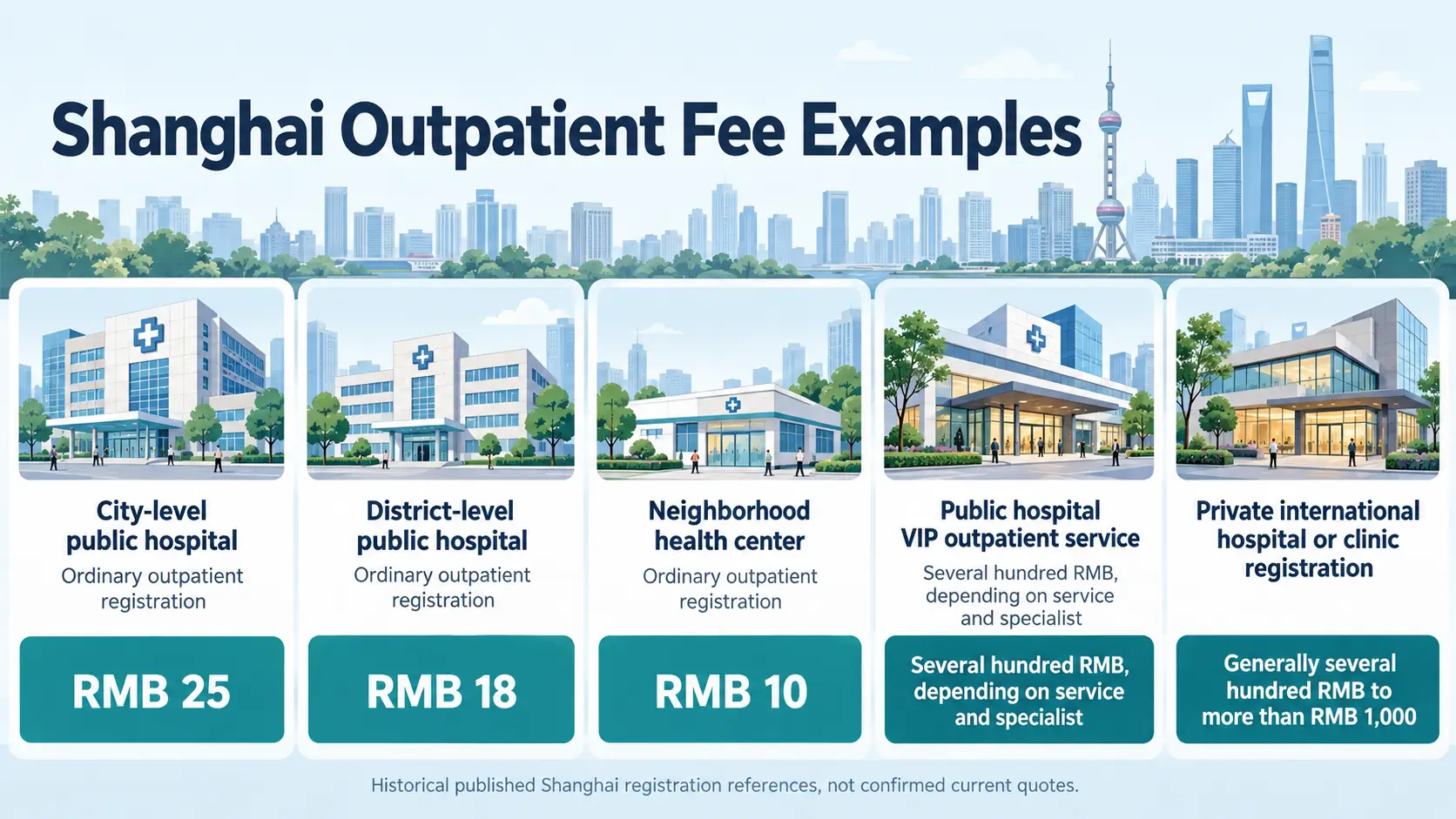
An official Shanghai government guide to public and private hospitals published in August 2025 provides examples of registration fees across healthcare settings.
| Healthcare setting in Shanghai | Published fee reference |
|---|---|
| City level public hospital ordinary outpatient registration | RMB 25 |
| District level public hospital ordinary outpatient registration | RMB 18 |
| Neighborhood health center ordinary outpatient registration | RMB 10 |
| Public hospital VIP outpatient service | Several hundred RMB depending on service and specialist |
| Private international hospital or clinic registration | Generally several hundred to more than RMB 1,000 |
These are historical Shanghai registration references, not confirmed prices for 2026, nationwide averages or full treatment quotations. Current charges and eligibility must be checked with the relevant institution. Registration may not include investigations, prescribed medicines or specialist procedures. A patient whose consultation leads to imaging, laboratory testing or surgery can face substantial additional expenses.
The distinction also matters when comparing public and international outpatient routes. A standard clinic visit may be suitable for some routine concerns, whereas another patient might need a hospital department equipped for more complex assessment. Published prices should never be used to decide which setting is clinically appropriate. If the hospital cannot confirm the intended specialty, service package or applicable patient registration category, the financial comparison remains preliminary. Ask for the current charge from the department through which the visit would actually be arranged.
Published Fees, Preliminary Estimates and Final Hospital Bills
A published fee is the charge listed for a defined service, such as registration or a particular examination. A preliminary estimate describes expected charges based on information currently available. A final hospital bill reflects services actually provided and the hospital billing rules. These figures can differ if the clinical plan or length of care changes.
Two prices should not be compared until their medical scope is reasonably comparable. A quotation for a procedure alone may exclude diagnostics, hospitalization or follow up that another estimate includes. Begin by confirming the proposed service and obtaining a clear explanation of the charges relevant to your circumstances.
For planned treatment, additional details may include whether the physician has reviewed prior records, whether the proposed procedure is contingent on fresh tests and whether expected inpatient care has been discussed. A preliminary estimate produced before these steps may be valuable for early financial planning, but it should not be mistaken for a firm offer that covers every outcome. The more medically complex the inquiry, the more important it becomes to obtain a clear explanation of the assumptions behind the amount.
What Determines Medical Costs for International Patients?
Costs depend on the clinical services required and the channel through which a patient accesses them. Two patients asking about similar conditions may receive different estimates because they need different examinations, services or arrangements. Identifying these variables helps prevent misleading price comparisons.
General Outpatient, International Medical and Private Hospital Services
Public hospitals may operate ordinary outpatient services alongside international medical departments. Private international institutions may provide separate appointment, language and insurance arrangements. Charges can differ between these pathways even within a single hospital. Patients should confirm which department accepts their inquiry, which specialists and services are available and what its specific fee schedule covers.
The Beijing government guide to Peking Union Medical College Hospital describes international services, multilingual support and appointment arrangements. This is an institutional example, not a nationwide rule. Paying more for service conveniences does not itself establish superior clinical outcomes, and a lower publicly listed outpatient charge may not be available for every international patient.
International patients should also check whether language support is available during the actual clinical consultation, not only during appointment registration. An interpreter or translated medical records may be billed separately, and arrangements can differ between departments within the same institution. If an advertised international service includes additional assistance, confirm exactly which functions are covered. Administrative convenience can be an important part of travel planning, but it should be evaluated separately from medical necessity, provider qualifications and the clinical scope of care.
Treatment Scope, Diagnostics and Clinical Complexity
A health assessment may include a defined set of screening tests, with additional investigations if indicated. Dental care may require imaging, restorative materials and several visits. Knee replacement may involve a prosthesis, anesthesia, hospital stay, rehabilitation and follow up. Complex treatments can also require specialist evaluation, monitoring or management of complications.
These examples describe different cost structures, not fixed prices. A clinician must determine whether a proposed treatment is appropriate, and additional assessment may change its scope. Ask the hospital which clinical assumptions underlie the estimate and whether it includes examinations or aftercare needed for the proposed pathway.
If a patient already has a diagnosis and previous treatment records, a hospital may be able to clarify certain expected cost components before arrival. If the diagnosis is uncertain or investigations are outdated, the institution may only be able to provide a provisional estimate for an initial assessment. Neither situation should be presented as an individual treatment recommendation. The patient should understand which decisions can be made before travel and which depend on a later in person examination, specialist judgment or updated testing.
What Should Be Included in a Hospital Cost Estimate?
A useful hospital estimate identifies expected services, included items and possible separately billed expenses. It should help patients evaluate a proposed care plan instead of presenting only a headline price. Not every cost category applies to every patient, but each relevant category should be checked.
Hospital Charges and Services That May Be Billed Separately
| Cost component | What patients should verify |
|---|---|
| Consultation | Specialist appointments, additional consultations and medical reviews |
| Diagnostics | Laboratory testing, imaging, pathology and repeat examinations where relevant |
| Treatment | Procedure scope, anesthesia, implants, medical supplies and special materials |
| Hospital stay | Room category, expected length of stay, nursing care and additional nights |
| Medication | Included medicines and prescriptions billed separately |
| Follow up | Reviews, rehabilitation and care needed after returning home |
A routine consultation may not involve anesthesia or hospitalization. For planned surgery, these categories may become central to the overall budget. Patients should identify reasonably anticipated services and ask how further clinical findings could change the charges. The CDC guidance on medical tourism also highlights complications and continuity of care as important considerations when planning treatment abroad.

Confirmed, Estimated and Unconfirmed Charges
Confirmed charges have an identified applicable fee or rule from the provider, although they may not amount to a guaranteed final bill. Estimated charges are anticipated amounts that may change as treatment requirements become clearer. Unconfirmed charges still need verification of their amount, applicability or payment responsibility.
For example, a hospital may confirm the consultation charge but explain that imaging will be determined after examination. The consultation fee is known, while the imaging expense remains uncertain. Patients should record this difference instead of assuming every item on an initial estimate is fixed.
An especially useful practice is to keep a simple written record of each unanswered financial question, the person or department responsible for answering it and the response received. This makes it easier to distinguish factual confirmation from assumptions. It also helps avoid confusion when several organizations participate in a medical journey. A charge should remain unconfirmed until the relevant provider has supplied an answer that applies to the proposed service and patient circumstances, rather than an unrelated public example.
Hospital Fees, Coordination Fees and Travel Expenses
Hospital fees cover medical services. Separate coordination fees may cover document organization, appointment communication or language assistance. Flights, hotels and local transport may be charged by other providers. Confirm who provides each service, who receives payment and which items belong to the hospital bill or another agreement.
A combined quotation can be convenient, but it should not blur these responsibilities. RegenComp explains the distinction further in its medical tourism facilitator services guide.
How Can International Patients Request a Reliable Medical Cost Estimate?
A useful estimate starts with a sufficiently clear healthcare inquiry. Hospitals need to understand the proposed service and may need to review existing medical information before estimating likely charges. Patients can begin an inquiry without a final diagnosis, but the level of detail available affects the reliability of the response.
Prepare the Medical Information Relevant to Your Inquiry
Explain the purpose of the proposed consultation or treatment. For a health checkup, screening goals and relevant medical concerns may be sufficient for initial communication. A specialist inquiry can require existing reports, while an inquiry about established disease may need treatment summaries or imaging records. Requirements depend on the hospital and clinical question.
- Existing diagnosis or referral letter, where available.
- Relevant laboratory results, imaging reports and earlier treatment summaries.
- Current medication details and the questions you want addressed.
- Preferred travel period and language assistance requirements.
Ask what files, translations and recent examinations the receiving department needs. Use appropriate secure and authorized channels for sensitive health records. The RegenComp medical treatment preparation checklist explains how to organize documents for a hospital review.
Confirm the Hospital Department and Estimate Request Channel
Identify the relevant hospital department and confirm the accepted inquiry method. Some hospitals offer international service channels, while others rely on their regular registration system. Ask whether the department can review your case, whether specialist assessment must come first and what estimate can be given before attendance.
An administrative response, receipt of medical files, preliminary clinical review and confirmed appointment are distinct stages. A preliminary price does not mean that a physician has approved treatment. RegenComp can help with the communication process, but clinical eligibility and acceptance remain with the appropriate healthcare professionals and institution.
Verify the Issuer, Scope and Validity of the Estimate
Once a written estimate arrives, verify its source and the assumptions used. It should indicate the institution, relevant service, currency, issue date and included charges. Any excluded or conditional costs, payment arrangements and stated validity period should also be clear.
- Confirm the issuer and intended medical department.
- Check which procedures, tests, medicines and visits are included.
- Ask which charges are provisional or excluded.
- Confirm who collects payment and when the estimate may need updating.
If the treating team changes the proposed care after examination, request updated financial information. An unexplained total should not be treated as a comprehensive budget simply because it appears on a hospital document.
Patients may also wish to ask whether an estimate is valid only for a particular period, hospital campus, doctor or treatment scope. If the hospital has not provided an expiry date, do not assume the price can be relied on indefinitely. Explain any changes in medical history or travel timing that could affect the inquiry. Keep copies of written replies and official documents, while protecting confidential patient information. This record can support later clarification of payment obligations without implying that every stated estimate is contractually fixed.
How Should You Compare Hospital Estimates and Calculate the Total Budget?
The relevant decision is not which displayed number is smallest, but whether the proposed care is clinically appropriate and financially manageable. Compare equivalent services, include travel and follow up obligations and count insurance benefits only when sufficiently verified.
Compare Equivalent Services Before Comparing Prices
Consider a hypothetical patient receiving two estimates for dental treatment. One includes imaging, restorative materials and follow up, while the other quotes a lower total without specifying those services. The lower figure does not prove a lower final cost. Both estimates must be checked against their actual scope.
For major procedures, two similarly named treatments may not be clinically interchangeable. Ask a qualified specialist to clarify important differences and confirm whether the proposed care can be compared fairly. Also check how many visits, days in hospital or reviews each plan anticipates.
Comparison is most useful when each institution has answered the same questions about the expected consultation, investigations, procedure, stay, medication and follow up. A simple side by side worksheet can reveal omissions that a single total cannot. If the medical plans are different, record those differences instead of forcing a direct price ranking. If material cost components are missing, ask both providers for clarification before treating either proposal as financially preferable. The goal is an informed comparison, not a claim that the cheapest quotation is the safest or most suitable choice.
Include Medical, Travel and Follow Up Expenses
An overseas healthcare budget should cover anticipated hospital charges, other medical expenses, travel, accommodation, language or coordination support where applicable and aftercare. It should also leave reasonable flexibility for uncertain expenses without relying on an arbitrary universal contingency percentage.
- Expected hospital consultation, investigation and treatment charges.
- Extra clinical services not included in the initial estimate.
- Flights, accommodation, local transport and companion expenses.
- Recovery arrangements, necessary follow up and possible changes to the stay.
A short outpatient visit may require limited travel planning, while major surgery can involve a longer stay and additional medical reviews before travel is safe. The treating medical team should advise on recovery and travel fitness. CDC medical tourism guidance emphasizes complication planning and continuity of care after returning home.
The budget should also allow for practical limitations such as accompanying family members, accessible transportation or a longer period before a physician considers return travel appropriate. Recovery timelines are individual clinical matters, so patients should not book a fixed departure date on the assumption that everyone heals at the same speed. When home country follow up is needed, clarify in advance which professional will provide it and what medical records will be available. These arrangements can affect both safety and total expense.
Estimate Out of Pocket Costs After Verified Insurance Benefits
Insurance coverage can affect personal costs but must never be assumed. Some plans exclude planned overseas treatment; others require advance approval or reimbursement after the hospital has been paid. Even when later reimbursement is possible, a patient may need enough funds to settle the full immediate bill.
The CDC guidance on travel health insurance explains why coverage types and overseas payment obligations need careful review. Request written confirmation from your insurer and ask whether follow up care, complications or medical evacuation are covered. Only verified benefits should reduce the amount used in budget planning.
What Should You Verify Before Making a Payment or Travel Commitment?
A preliminary budget alone is not sufficient reason to make irreversible travel arrangements. Patients should confirm key payment rules, insurance responsibilities and whether the receiving hospital has established an appropriate medical pathway. Financial readiness and clinical suitability are separate questions.
Insurance, Preauthorization and Direct Billing
Ask the insurer whether planned care in China is covered, whether preauthorization is necessary and whether direct billing is available at the specific institution. Direct billing is different from paying first and claiming reimbursement later. Each arrangement can leave deductibles, exclusions or charges that the patient must pay.
The Beijing government medical guide describes insurance arrangements at participating institutions. Such services are not universal. Confirm applicable agreements and the receipts or medical records required for claims with both insurer and hospital.
Payment Methods, Deposits and Refund Conditions
International visitors can generally use several payment options in China, but a specific hospital may not accept all methods for every charge. The Chinese government payment guide discusses bank cards, mobile payments and cash for overseas visitors. Always verify the institution’s current requirements.
Before paying, confirm the currency, deposit, payment recipient, expected billing stages and itemized receipt arrangements. Obtain written cancellation and refund rules. The outcome may depend on timing, service agreements and care already provided. Payments to a coordinator should not be assumed to settle hospital charges without explicit documentation.
When Should You Pause Financial or Travel Planning?
| Planning status | Relevant condition | Appropriate action |
|---|---|---|
| Sufficient for preliminary budgeting | Major expected charges, scope and financial responsibilities are reasonably clear | Continue confirming medical and travel arrangements |
| More information needed | Important fees, insurance or hospital terms remain uncertain | Seek written clarification and an updated estimate |
| Delay irreversible commitments | Clinical acceptance or major financial obligations remain unresolved | Obtain hospital, insurer or professional confirmation first |
These categories describe financial and administrative readiness, not eligibility for treatment. A clear budget does not replace clinical assessment, and an appropriate treatment proposal does not establish financial affordability. Patients needing urgent medical attention should seek appropriate local care rather than delay assessment for overseas arrangements.
Even when an initial estimate looks affordable, travel commitments may be premature if the relevant department has not confirmed an appointment or the patient does not know what further assessments are needed. Conversely, fully understanding the budget does not mean that international travel is necessary or preferable. Patients should consider their alternatives and obtain appropriate medical advice. The purpose of financial verification is to make the practical consequences of the decision clearer, not to pressure a patient into proceeding with treatment abroad.
How Can RegenComp Help Coordinate a Hospital Cost Inquiry?
Contacting hospitals across borders can involve unfamiliar administrative systems, language differences and varying document requirements. RegenComp supports international patients exploring care in China by coordinating communication, helping organize relevant information and clarifying practical arrangements.
Depending on the patient’s needs and the agreed service scope, support may include preparing documents for an inquiry, identifying relevant hospital contacts, arranging appointment communication and seeking clarification of available cost information. The hospital determines the applicable medical charges, and licensed professionals remain responsible for diagnosis, treatment eligibility and clinical recommendations.
Any coordination charges should be explained separately from hospital bills. Patients who can communicate directly with a preferred hospital may choose to do so. Those needing administrative or language support can consider whether coordination would help them obtain and understand the information required for a responsible decision.
Request Help With a Hospital Cost Estimate
If you are considering planned care in China, identify the service of interest and gather any relevant records already available. You may then contact RegenComp to discuss what information may be required for an initial hospital cost inquiry and which coordination services may be available.
An inquiry is not a commitment to treatment or travel. The goal is to understand the proposed healthcare pathway, outstanding financial questions and the medical or administrative confirmations still needed. A sound decision rests on appropriate clinical care, transparent costs and realistic follow up arrangements rather than incomplete price claims.